ATO residual value table for novated leases (28.13% explained)
Residual value is one of the most important variables in a novated lease, and misunderstanding it is a major reason people misjudge whether a lease is good value.
Unfortunately, some novated lease providers do not adequately explain residual values to first‑time lessees. As a result, some people are surprised to discover that they still owe tens of thousands of dollars at the end of the lease if they wish to keep the vehicle.
What a residual value actually is
In a novated lease, the residual value (sometimes called a balloon payment) is the amount you still owe at the end of the lease term if you want to keep the vehicle.
It is not optional.
At the end of the lease, you must either:
- pay the residual and keep the car, or
- refinance the residual into a new lease or loan, or
- sell the car (or return it via the provider) and use the proceeds to clear the residual.
Regardless of which path you take, the residual is a real financial liability that does not disappear.
ATO residual value table
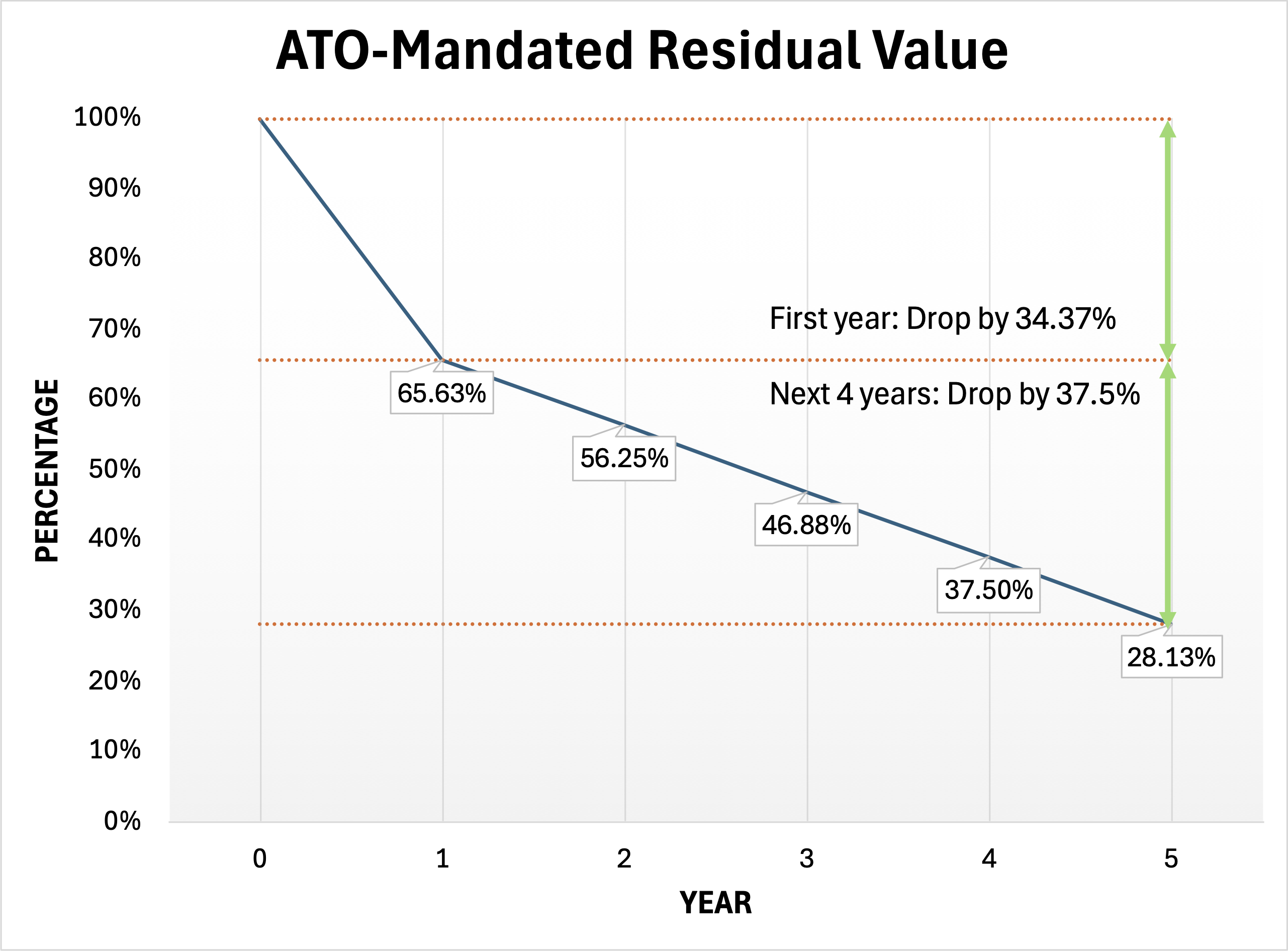
Residual values are not set at random.
They are constrained by ATO minimum residual guidelines, which specify the lowest residual value permitted for a given lease term.
In particular:
- 1 year lease → 65.63% residual
- 2 year lease → 56.25% residual
- 3 year lease → 46.88% residual
- 4 year lease → 37.50% residual
- 5 year lease → 28.13% residual
Providers may set residuals above these minimums, and in the ordinary case they cannot set them below — though there is a narrow provision for going lower, covered further below.
Residual value is deferred payment, not savings
A common psychological mistake is to treat the residual as a distant problem:
“I’ll worry about that later.”
From a financial perspective, this is incorrect.
A novated lease simply divides the cost of the car into:
- amounts paid during the lease term, and
- a large lump sum paid at the end.
Ignoring the residual is equivalent to ignoring part of the purchase price.
This is exactly why residual values must be included when assessing whether a novated lease makes sense overall. You can see how residual values form part of the net financial outcome when you model realistic scenarios in the novated lease calculator.
Market value ≠ residual value
Another common misconception is that the residual reflects the expected future market value of the car.
It does not.
The residual is an accounting construct, not a valuation estimate or guarantee.
As a result, the car’s market value and the end‑of‑lease residual value are independent variables. When evaluating the total financial outcome of a novated lease, both must be considered separately.
Asking for a lower residual value
That independence runs one way, though. The residual is not derived from your car’s expected market value — but a credible estimate of that market value is the one thing that can move it.
The table above is the default, not an absolute floor.
Those minimums come from Taxation Determination TD 93/142 — Income tax: in calculating the residual value of a leased item, may a lower residual value than those outlined in IT 28 be adopted in light of the more generous depreciation rates? — and the same determination provides for going below them.
Paragraph 4:
A residual value lower than those outlined in the applicable table may be used where a well considered and fair estimate of the likely market value of the item at the end of the lease would result in a lower value.
So if you have genuine reason to believe your car’s market value at the point of payout will be significantly below the table figure, you do have the ability to ask for a lower residual value.
The two worked examples in the determination approach the same point from the other direction, and are the clearest statement of how it operates. Each concludes that “in the absence of evidence indicating that the car would have a lower market value at the end of the lease”, the minimum applies. The table is what you fall back to when nobody has made a case — not a ceiling on making one.
What this looks like in practice
Two practical constraints matter more than the legal test:
- It is typically only entertained where your mileage is high — say, more than 30,000 km a year. That is the clearest case of a car predictably falling well below the standard depreciation assumption, and it is the scenario providers and financiers are used to assessing. Worth being precise here: this threshold is industry practice, not law. Paragraph 4 sets no kilometre figure and asks only for a “well considered and fair estimate”.
- You have to pencil it in at the start. The residual is fixed when the lease is written. It is not something you can revisit in year four once the car’s actual market value has become obvious. If you expect high kilometres, raise it during the quoting stage, before anything is signed.
All else being equal — that is, if you can obtain the same effective interest rate — a lower residual makes the car genuinely cheaper, not merely rescheduled.
The reason is the pre-tax/post-tax split. Lease payments come out of pre-tax salary; the residual at the end is paid with post-tax money. Lowering the residual moves part of the car’s value out of the balloon and into the payments, so a larger share of the car is paid down in pre-tax dollars over the course of the lease — and that portion attracts the tax saving that the balloon never does.
On a $60,000 car over five years, dropping the residual from 28.13% ($16,878) to 20% ($12,000) shifts $4,878 from the post-tax balloon into pre-tax lease payments. On a 47% marginal rate that is roughly $2,300 of additional tax saving, on exactly the same car. Two smaller effects push the same way: total interest falls slightly, because the average outstanding balance is lower; and less of the car’s value is left sitting in a residual that carries GST you cannot recover.
The trade-off is cash flow, not cost — your periodic deductions rise. And there is a second benefit worth having in its own right: exposure at payout. If high kilometres mean the car will be worth well under the standard residual, that gap is money you are liable for regardless; a lower residual brings the contractual figure closer to reality instead of deferring the shortfall to the end.
The ATO’s intent behind residual values
Many people understand what the residual or balloon payment is, but struggle to understand why it exists at all.
The answer is simple: because the ATO requires it.
The concept of a mandatory minimum residual value was introduced by the ATO decades ago, first in IT 28 (1960) and later clarified in TD 93/142 (with subsequent addenda).
You can read those rulings directly, but they are dense, technical, and heavy on legal terminology.
The short version is this:
Residual values exist to ensure that leases are genuine leases, not disguised loans.
From the ATO’s perspective, a lease is meant to be meaningfully different from a loan.
If leases were allowed to run down the value of an asset to a token amount (for example, claiming that a car is “worth $50” after a two‑year lease), they would effectively become fully tax‑deductible loans in disguise.
To prevent this, the ATO enforces minimum residual values that:
- assume the asset still has some remaining economic value at the end of the lease, and
- very coarsely correspond to real‑world depreciation over time.
In other words, residual values exist to protect the tax system from abuse. They ensure that lease payments broadly reflect depreciation of the asset rather than its full cost.
How was residual value derived?
At first glance, the ATO residual table can look like a random list of percentages across 1 to 5 years.
It isn’t.
There is explicit mathematics behind these numbers, laid out in TD 93/142.
The underlying assumption is that:
- the car is assumed to start at 75% of cost at year 0, and
- its effective life is assumed to be 8 years,
- therefore its value is assumed to decline linearly by one‑eighth of 75% each year.
Mathematically:
This explains the residual table directly:
- Year 1:
- Year 2:
- Year 3:
…eventually reaching 0% at year 8.
This derivation is explicitly described in TD 93/142 using the formula, where = minimum residual value (as a percentage of cost) and = lease duration in years:
Although the published table uses whole years, it is derived from a linear equation.
What “cost” does the percentage actually apply to?
The ATO’s residual percentages (28.13% for a 5‑year lease, and so on) are unambiguous. What is less clear — and where providers genuinely differ in practice — is what dollar figure that percentage is applied to. Most of the ATO’s own documentation (IT 28, TD 93/142) refers only to the car’s “cost,” without elaborating on what is truly incorporated in the cost.
In practice, there are two methodologies in use:
Method A (the more common approach — used by almost every financier except CBA):
Cost base = drive‑away cost − GST saved (capped at $6,353 this financial year)
Method B (used by CBA specifically):
Cost base = pre‑on‑road price of the vehicle − GST saved (capped at $6,353 this financial year)
Note that the documentation fee is not part of the residual cost base under either method — it’s only added into the separately‑calculated financed amount used for interest purposes. The real difference between the two methods is narrower than it first appears: Method A starts from the drive‑away cost (which includes on‑road costs — stamp duty, registration, CTP), while Method B starts from the pre‑on‑road price, excluding those on‑road costs from the base entirely.
Method B will always produce a lower dollar residual than Method A for the same vehicle, by the amount of on‑road costs excluded from the base.
This calculator defaults to Method A — the residual field is automatically pre‑filled using this formula — but you can override it with any figure you like, including a Method B figure if your quote is CBA‑financed.
The ATO is not particularly clear on which is “correct” — the guidance simply isn’t specific enough to settle it either way.
There is one ATO example that arguably leans toward Method B: the “Patrick” example in the ATO’s Car leasing and FBT guidance:
Patrick’s employer plans to provide him with a new car for private use, to the value of $40,000, under a novated lease. Patrick chooses a car with a purchase price of $41,600, which includes $1,600 in on-road costs (registration, stamp duty, and dealer delivery fee). Patrick pays the car dealer $1,600 of his own money to cover the on-road costs…
…residual value is calculated as 46.88% of $40,000 = $18,752… For the purpose of calculating the taxable value of the car fringe benefit, the base value of the car is $40,000.
Here, the $40,000 residual base excludes the $1,600 of on-road costs entirely — consistent with Method B’s “strip out everything except the core vehicle price” approach.
There is a slight discrepancy: in the Patrick example, Patrick pays the $1,600 on-road cost himself, directly to the dealer — it never forms part of the financed amount at all. That’s a different scenario to a typical novated lease, where on-road costs and the GST saving both flow through the financed amount together. So while this is the closest thing to explicit ATO support for Method B, it isn’t a precise match for how CBA (or any financier) actually applies the formula in a standard novated lease.
Why this matters to you: the residual value is one of the inputs used to back out the effective interest rate from a lease’s monthly payments. Once two financiers are using different residual values for the same percentage, their quoted “effective interest rates” are no longer directly comparable — a 9% rate calculated against a Method A residual is not the same economic deal as a 9% rate calculated against a Method B residual.
In practice, this means you shouldn’t try to compare a CBA‑financed quote against a quote using a different financier purely on effective interest rate. Instead, compare the full out‑of‑pocket impact of both — the monthly finance repayments and the final residual payment, added together over the life of the lease — rather than relying on the EIR figure alone to judge which deal is better.
The friction this causes with BYO finance
This mismatch can also cause a practical problem if you’re arranging a BYO / self‑managed novated lease and your chosen financier is CBA. Some novated lease providers will refuse to accept a CBA‑derived Method B residual, citing it as “too low” and non‑compliant.
Strictly speaking, that objection isn’t well‑founded on its own: Method B still applies the exact same ATO‑mandated percentage as Method A — it’s simply applying that percentage to a smaller cost base (pre‑on‑road price rather than drive‑away cost). A lower dollar residual calculated this way isn’t automatically below the ATO’s minimum; it’s a different — and arguably, per the Patrick example above, at least as defensible — interpretation of what “cost” means.
In practice, though, this is exactly the kind of grey area a risk‑averse novated lease provider would rather avoid. If you run into this pushback, it’s worth understanding that it may reflect the provider’s own internal compliance comfort rather than a clear ATO ruling against Method B.
How is the residual defined for 13‑month or other non‑integer lease durations?
The complication arises with non‑integer lease terms, such as 13 months or 18 months.
The ATO does not publish worked examples showing how to apply the residual formula to fractional years. This lack of explicit guidance has led to a range of creative and sometimes questionable approaches in the industry.
The most common approach is:
rounding up a 13‑month lease to 2 years
and applying the 2‑year residual value.
By doing this:
- more of the car is paid down using pre‑tax dollars,
- interest is only accrued for 13 months,
- running costs that would normally fall into a second year may also be claimed,
- while the residual is calculated as if the lease ran for 24 months.
From a purely numerical perspective, this can increase savings.
The mathematically consistent approach
The mathematically consistent way to handle non‑integer terms would be to apply the formula directly.
For example, for a 1.5‑year lease:
The risk trade‑off of using next‑integer‑year residual values
Some novated lease providers and financiers still choose to use the “round up to the next year” approach.
If they do so, you may indeed derive greater tax savings.
However, this sits on murkier legal ground.
The further the applied residual deviates from what the underlying ATO model implies, the greater the risk that the arrangement could be challenged as not being a genuine lease if the ATO were to scrutinise it more closely.
In other words:
Higher savings may come with higher compliance risk.
How residual values work when a lease is extended
A common misunderstanding is how residual values behave when a novated lease is extended (for example, 1 + 1 + 1 years).
When you extend a lease, the car’s residual value does not compound on itself.
In other words, it does not become:
65.63% of 65.63% of 65.63%
Instead, the residual continues to follow the original ATO residual table, calculated as a percentage of the original vehicle value.
For example:
- end of year 1 → ~65.63% of original value
- end of year 2 → ~56.25% of original value
- end of year 3 → ~46.88% of original value
This is true even if the lease is structured as consecutive extensions rather than a single multi‑year lease.
The ATO made this explicit in TD 93/142, including worked examples (see Example 3). This clarification around lease extensions was reinforced in the 2021 addendum, which inserted Example 3 and confirmed that the minimum is calculated on the total period the asset has been leased, across consecutive leases.
It is worth noting that some novated lease providers and financiers still apply a “repeated 65.63%” style calculation when leases are extended (i.e. compounding the residual on the prior residual rather than referencing the original vehicle value).
This approach sits in a legally murky and risky area, and risks the lease no longer meeting the ATO’s definition of a genuine lease.
Key takeaway
If you remember nothing else:
Residual values are an ATO‑enforced constraint designed to prevent leases from becoming tax‑deductible loans. Understanding the legislation becomes particularly important if you are considering non-standard arrangements, such as lease extensions or non-integer-year lease terms.
They represent deferred payment for part of the car’s cost that was never eligible for tax savings.
This calculator and guide are built and continuously maintained as an independent project.
If it has helped you think more clearly, avoid a costly mistake, or saved you meaningful money, you're welcome to support its ongoing maintenance and improvements:
- Buying me a cuppa ☕ to help cover hosting, development time, and future improvements, or
- Using this Tesla referral link for a $350 discount if you're ordering a Tesla.
I'm backing Dr Michael Keane's fight for salary packaging transparency
Workplaces with an exclusive salary packaging provider tend to have noticeably higher effective interest rates on novated leases — yet the commercial terms behind these exclusive arrangements are rarely disclosed to employees.
Dr Michael Keane, a Melbourne anaesthetist, is taking a Victorian health service to the Victorian Supreme Court to obtain the unredacted contract between the hospital and its exclusive salary packaging provider. The unredacted version may shed light on alleged sign-on fees associated with exclusive access to hospital employees — an arrangement whose financial terms employees are rarely privy to.
To date, Dr Keane has personally spent around $15,700 pursuing this case, with further legal costs anticipated. I believe this matters to anyone in a workplace with an exclusive provider. If you agree, consider supporting his  GoFundMe.